 |  |
If a human being were to befriend us just so s/he could use us for whatever purpose s/he found us useful for, we wouldn't be friends or even interact with this individual. We would feel used and exploited; thus, probably severing the relationship. Yet this is the way we look at and treat plants and animals much of the time in the modern world. When I do an internet search of a plant like Gingko biloba, the first things that pop up about it are, "benefits, uses and side-effects." Very little is actually discussed about who, what, where, when and how this being really is.
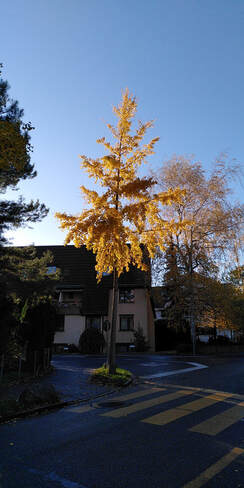
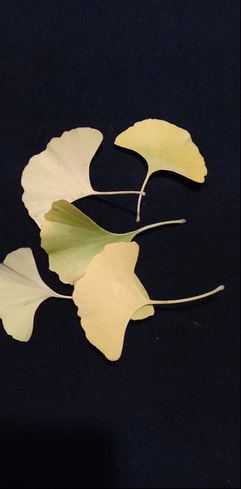
If we were to research further, we would realize that Gingko is one of the oldest living species on the Earth, unchanged for more than 200 million years. It is one of those trees that you would spot straightaway, once you came to know it, as its shape and leaves are unique. No other plant has this distinct fan-shape leaf like the Gingko does. In spring-summer, they are green, what I would describe like a fresh green. In autumn, they turn a bright golden-yellow; amazingly vivid colors. It can grow very tall, up to 35 meters and has a slender, pyramid-form when it's younger. Genetically it is old and has no other relative plants that bear its code. Imagine this, the Gingko lived in the time of the dinosaurs, which died out, but the Gingko and other plants, such as ferns, outlived them and still thrive today. They will probably also outlive us, homo sapiens and other human species, too.
Botanists trace the origins of Gingko biloba to China. Then it began spreading to Japan and Korea, into cities and into to the Western world. Even today, many cities in the world have streets lined with Gingko trees, which provide a welcomed shade in overheated cities, needing very little care, as it's a hardy being that can withstand cold and disease. The female plant produces fruit, that look like nuts, but the outer layer of the fruit produces butyric acid, which smells like vomit. This you will smell as you pass by the tree as it is fruiting but once the peel falls off, the smell dissipates. These nuts are often collected and eaten in Asia, this is the part of the plant that is used in Chinese Medicine. In the West, sometimes Gingko is known as Maiden Hair, a name probably inspired by how the leaves hang off its branches. The Chinese call it Yín Guǒ, Silver Fruit, (probably where the name Gingko comes from) or Bái Guǒ, White Fruit. The Chinese have known of Gingko for over 1000 years, where there are still some wild Gingko tree growing. The leaves were never used as medicine until Westerners began to market it as cognitive-enhancers. In the Chinese Materia Medica, the fruit is used for Lung conditions, like wheezing, and for astringing fluids in the lower body, like for excessive vaginal discharge (leucorrhea) or urinary incontinence. It is categorized as bitter, sweet, astringent in flavor and neutral in temperature, entering the Lung and Kidney channel. But too much of it can be toxic, as with so many things. It is medicine when used in balance and respect, poison if overused and abused.
But never mind its medicinal effect on humans. It is a being in its own right. Its existence does not have to be justified on the basis of its use to us human beings. IT JUST IS. The next time you walk down the street, sense its presence and just be with Gingko. Maybe greet it with respect, like coming into the presence of an elder, and wonder at its amazing beauty, longevity and resilience.
Images by Elaine

 RSS Feed